
A missed call is rarely just a missed call. For a service company, practice, or local operation, it can be a job request that goes to the next business in the search results. That is why the cloud PBX versus onsite PBX decision should start with how your team handles calls, follows up on leads, and keeps working when plans change – not with a feature checklist.
A PBX, or private branch exchange, is the system that routes calls inside and outside your business. The real choice is where that system lives and who is responsible for keeping it operating. A cloud PBX runs through an internet-hosted service. An onsite PBX uses equipment installed at your office or facility.
Neither choice is automatically right. A small business with remote employees and multiple locations has different needs than a facility with specialized internal calling requirements. The best option is the one that reduces missed opportunities without creating work your team does not want to own.
Cloud PBX Versus Onsite PBX: The Core Difference
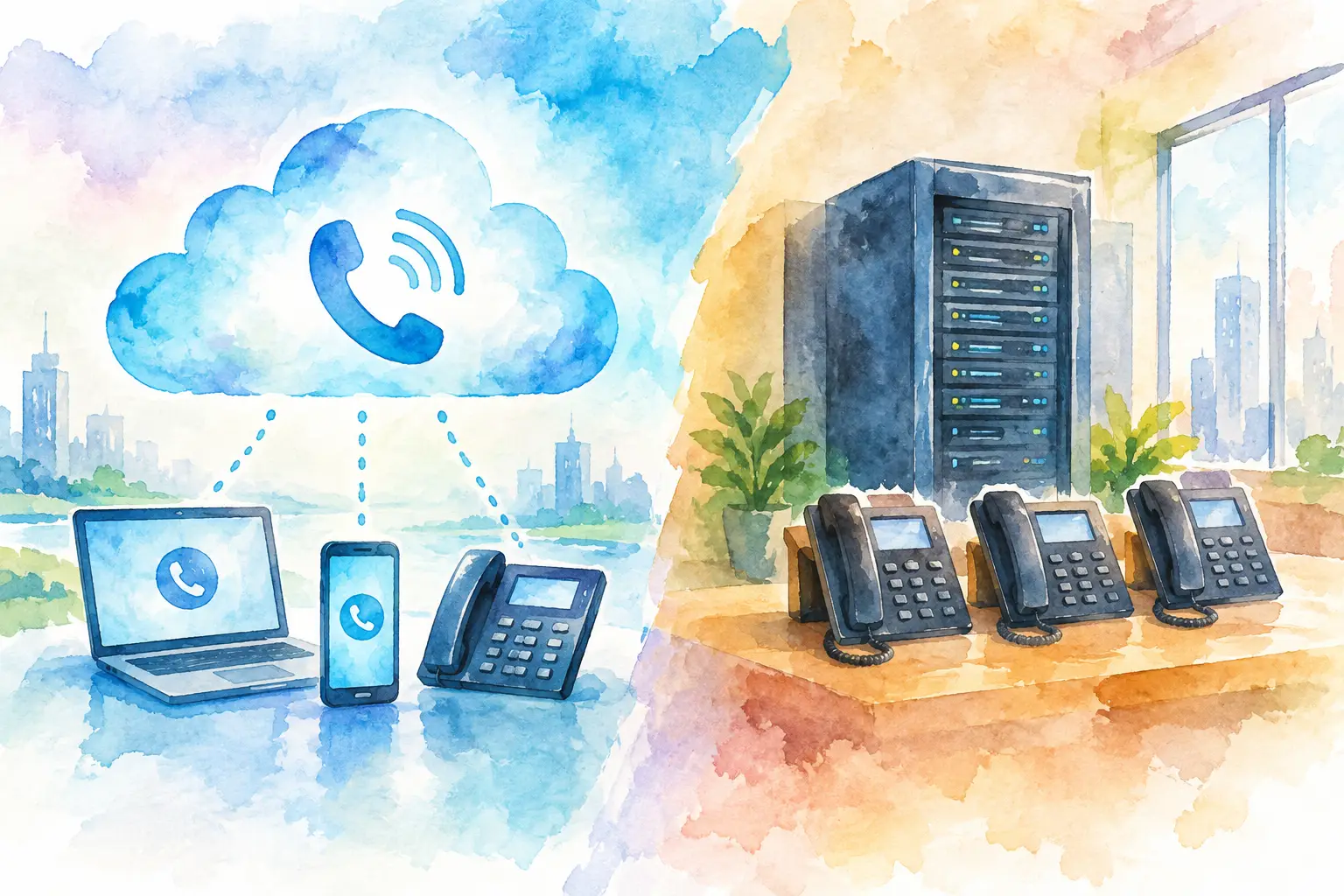
With a cloud PBX, the call-control platform is hosted outside your office. Your phones, mobile apps, desktop softphones, and other endpoints connect over an internet connection. Changes such as adding a user, updating a greeting, adjusting call routing, or opening a new location can usually be handled without installing new PBX hardware at each site.
With an onsite PBX, the central phone system sits in your building. Your company owns or manages the server, related equipment, software licenses, maintenance, and backup approach. Calls may still use internet-based phone service, but the intelligence that controls those calls remains on your premises.
That distinction affects cost, flexibility, continuity planning, and support. It also determines whether your phone system becomes another disconnected tool or a useful part of your sales and customer-service process.
Start With the Calls Your Business Actually Receives
Before comparing technical specifications, look at a normal week of calls. Do customers call one main number and expect the right department? Do calls need to ring a field technician’s mobile device after office hours? Does the receptionist need to see who is calling and whether that person is already a customer? Can a lead be sent an immediate text message when nobody answers?
These questions matter because a modern business phone system is not only a way to talk. It is a front door for prospects, customers, vendors, and employees. If a call is answered, logged, routed, and followed up consistently, the system supports growth. If it rings unanswered, lands in a generic voicemail box, or disappears from the record, it creates a leak in your marketing spend.
Cloud systems are often a better fit when calls need to follow people rather than desks. An estimator working across Lee and Collier counties, a manager working from home, or a growing team split between offices can answer through a business app without publishing personal numbers. The customer still sees one professional business identity.
An onsite system can make sense when the workforce is mostly in one location, internal extensions are heavily used, and the company has a clear reason to maintain its own communications equipment. The key phrase is clear reason. Owning the hardware should solve a meaningful operational need, not simply preserve an older setup.
Cost Is More Than the Equipment Invoice
Onsite PBX systems often appeal to businesses that prefer to make a capital investment and retain direct control over the equipment. That can be reasonable, especially when a business has stable staffing, a long-term facility, and internal technical resources. But the purchase is only the beginning.
An onsite approach can involve installation, server replacement, software updates, security management, battery backup, spare parts, support agreements, and the time required to troubleshoot issues. As the business adds users or locations, expansion may require more equipment and more planning. Those costs are not always visible when comparing an initial proposal.
Cloud PBX services generally shift more of that responsibility to the provider. Businesses typically avoid maintaining the central PBX server and can scale users up or down with less physical work. That makes spending more predictable for many small and mid-sized organizations, particularly those that would rather invest staff time in customers than phone administration.
Still, cloud is not automatically the least expensive option in every situation. A business with a highly stable, single-site operation and capable internal IT support may find an onsite investment justifiable over time. The better question is not, “Which option has the lower price?” It is, “Which option gives us the lowest total burden for the way we operate?”
Reliability Depends on Design, Not Just Location
Some owners assume onsite PBX is safer because they can see the equipment. Others assume cloud PBX is safer because the platform is hosted elsewhere. Both assumptions are incomplete.
An onsite PBX can keep certain internal calling functions available during an internet outage, depending on its configuration. But outside calling may still be affected, and the office remains exposed to local power loss, equipment failure, water damage, and other site-level problems. Someone must also own the responsibility for backups, replacement hardware, and recovery procedures.
A cloud PBX avoids making one office the single point of failure for the phone platform. If a Fort Myers office loses power during a storm or an internet issue, incoming calls can be routed to mobile devices, another location, or a temporary answering team. That is a meaningful advantage for businesses that cannot afford to be unreachable.
However, cloud calling depends on a dependable internet connection at the endpoint. Good implementation includes evaluating connection quality, configuring call forwarding and failover rules, and making sure employees know how to use their mobile or desktop calling tools. A weak office network will cause problems regardless of how modern the PBX platform is.
Flexibility Favors Cloud for Most Growing Teams
Growth introduces change. You hire a new coordinator, open a second location, add a seasonal department, or decide that after-hours calls should go to a rotating on-call schedule. With an onsite PBX, each change may require a technician, system programming, or additional hardware capacity.
Cloud systems are built for these changes. New users can receive extensions without rewiring an office. A department can have its own call queue and voicemail rules. Employees can move between a desk phone, computer, and mobile app while maintaining the same business caller ID. This is especially useful for organizations with field staff, hybrid roles, or multiple service areas.
Flexibility should not mean uncontrolled complexity. Too many menus, queues, forwarding rules, and voicemail boxes can frustrate callers and employees. The goal is a call path that feels simple to the customer: call one number, reach the right person, get a response.
CRM and Follow-Up May Be the Deciding Factor
A phone system should not operate in isolation from the rest of your customer process. When call information connects to a CRM, staff can see prior conversations, capture call outcomes, assign follow-up tasks, and track whether a new inquiry became a customer.
This is where cloud PBX usually has a practical advantage. Its software-based structure makes integrations, call notifications, text messaging, recording policies, and automated follow-up easier to manage. With an integrated approach such as IP2Speech and Client Connect Suite, a missed call can trigger a prompt response workflow instead of relying on someone to remember to check voicemail later.
Automation should support people, not pretend to replace them. An automatic acknowledgment after hours can set expectations. Intelligent routing can send a caller to the right department. But a complicated estimate, an upset customer, or a high-value sales conversation still needs a capable person who understands the business.
Onsite PBX integration is possible, but it may require more custom configuration and ongoing management. If your team depends on phone data to support sales, service, and reputation management, ask specifically how calls will appear in your existing workflow. Do not accept “it integrates” as a complete answer.
When Onsite PBX Is Still the Better Choice
Cloud PBX is the practical default for many businesses with 5 to 100 employees, but onsite PBX remains appropriate in a few cases. It may fit an organization with strict internal control requirements, specialized equipment that depends on local call processing, a single permanent facility, and staff prepared to manage communications infrastructure.
It can also be a reasonable choice when internet connectivity is consistently limited and local calling continuity is more valuable than remote access. Even then, the system should have a documented maintenance plan. A phone server that nobody understands is not control. It is a future emergency.
Choose the System Your Team Can Run Well
The right phone system is the one your employees will answer, your managers can adjust, and your customers can rely on. For most growing service businesses, cloud PBX offers the better path because it supports mobility, easier changes, business continuity, and connection to the systems that handle leads after the call ends.
But the decision should be made from your operating reality. Map your call flow. Identify where calls are missed. Consider who will maintain the system. Test what happens if your office internet or power goes down. Then choose the setup that makes it easier for a real customer to reach a real person when it matters.